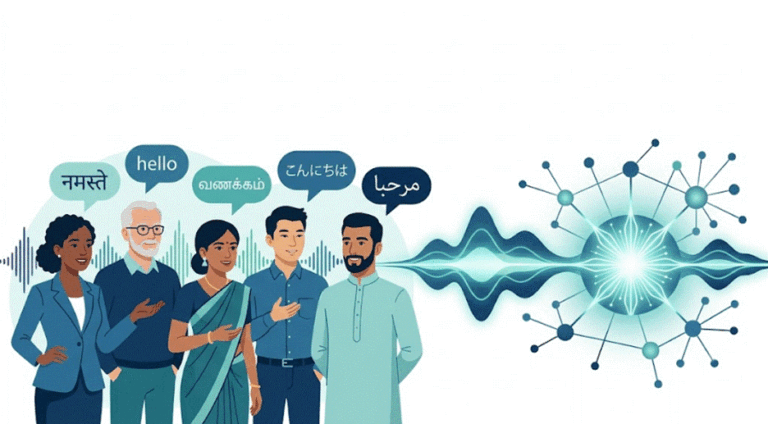

Customer support has always been one of the largest operational expenses for businesses. Whether a company serves hundreds of customers or millions of users, providing timely and effective support requires significant resources. Businesses must hire agents, provide training, maintain support systems, and ensure customers receive assistance whenever they need it. As customer expectations continue to rise, support departments are under increasing pressure to deliver better service without dramatically increasing costs.
Fortunately, advances in artificial intelligence have created new opportunities for businesses to improve efficiency. Modern chatbots are no longer limited to answering a few simple questions. They can now handle conversations, understand customer intent, provide personalized responses, and assist users across multiple channels. This evolution has made chatbots one of the most valuable tools available for reducing support costs while maintaining customer satisfaction.
Many businesses interested in implementing conversational AI solutions work with specialists through platforms such as Zinn Hub chatbot developers to build custom chatbot systems that align with their customer service goals. As AI technology continues advancing, organizations are discovering that chatbots are not simply support tools—they are becoming essential assets for controlling operational expenses and improving customer experiences.
Customer Expectations Are Higher Than Ever
Today’s consumers expect immediate assistance.
When customers encounter problems, they want:
- Quick answers
- Accurate information
- 24-hour availability
- Convenient communication
- Fast problem resolution
Meeting these expectations traditionally required larger support teams and increased staffing expenses.
For growing businesses, support costs often increase alongside customer growth. More customers usually mean more inquiries, more tickets, and more support agents.
Chatbots help break this cycle by allowing businesses to serve more customers without increasing support costs at the same rate.
1. Automating Frequently Asked Questions
One of the most common reasons customers contact support teams is to ask routine questions.
Examples include:
- Where is my order?
- How do I reset my password?
- What are your business hours?
- How can I update my account?
- What is your return policy?
Although these questions are important, they rarely require human expertise.
Modern chatbots can instantly provide accurate responses without involving a support representative.
This reduces the number of incoming tickets while freeing support teams to focus on more complex customer needs.
For businesses receiving hundreds or thousands of repetitive inquiries each month, automation can generate substantial cost savings.
Reducing Ticket Volume
Support costs are closely tied to ticket volume.
The more tickets a company receives, the more resources are required to manage them.
By automatically resolving common inquiries, chatbots can significantly reduce:
- Support queues
- Response times
- Staffing requirements
- Operational workloads
Lower ticket volume often allows businesses to maintain excellent service without continuously expanding their support departments.
This becomes especially valuable during periods of rapid growth.
2. Providing Support Around the Clock
Traditional customer service teams operate within defined schedules.
Even organizations with extended support hours often struggle to provide true 24/7 coverage without significant staffing investments.
Chatbots solve this problem.
Unlike human representatives, chatbots can assist customers:
- During weekends
- On holidays
- Late at night
- Across different time zones
This continuous availability improves customer satisfaction while reducing the need for overnight shifts and additional personnel.
Businesses serving global audiences particularly benefit from around-the-clock support because customers can receive assistance regardless of location.
See also: Digital Tailoring and Fashion Technology
Supporting International Customers
Many companies now serve customers worldwide.
Different regions operate in different time zones, making constant support difficult to maintain through human teams alone.
Chatbots allow businesses to provide immediate assistance to international customers without establishing support centers in multiple locations.
This improves customer experiences while keeping operational expenses under control.
3. Speeding Up Issue Resolution
Customers dislike waiting.
Long response times frequently lead to frustration, lower satisfaction scores, and increased support costs.
Chatbots improve efficiency by responding immediately.
Instead of waiting for an available support agent, customers can begin receiving assistance within seconds.
Modern chatbot systems can:
- Gather customer information
- Verify account details
- Identify common issues
- Suggest solutions
- Escalate complex cases
This process shortens resolution times while reducing the workload placed on support teams.
Faster resolutions often lead to happier customers and lower operational expenses.
Improving Agent Productivity
Even when human assistance is required, chatbots can make support representatives more efficient.
By collecting information before escalation, chatbots provide agents with valuable context.
This allows representatives to:
- Understand issues faster
- Avoid repetitive questions
- Resolve cases more quickly
- Handle more customers per day
Increased productivity often reduces the need for additional hiring as businesses grow.
4. Lowering Training and Staffing Costs
Building a support team requires more than simply hiring employees.
Businesses must also invest in:
- Recruitment
- Training
- Onboarding
- Quality assurance
- Ongoing management
These costs can become significant, particularly in organizations experiencing rapid growth.
Chatbots help reduce staffing requirements by handling a large percentage of routine interactions automatically.
As a result, businesses often need:
- Fewer new hires
- Smaller support teams
- Less training investment
- Reduced management overhead
This creates long-term savings that continue growing as support demands increase.
Maintaining Consistent Responses
Human agents naturally vary in experience, communication style, and knowledge.
This can sometimes result in inconsistent customer experiences.
Chatbots provide standardized responses based on approved information.
Every customer receives:
- Accurate information
- Consistent messaging
- Reliable guidance
- Uniform service quality
Consistency reduces misunderstandings and minimizes the need for corrective support interactions.
5. Scaling Without Increasing Labor Costs
One of the most significant advantages of chatbot technology is scalability.
Traditional support models require businesses to hire additional staff as customer numbers increase.
This creates a direct relationship between growth and support expenses.
Chatbots change this equation.
A properly designed chatbot can assist thousands of customers simultaneously without requiring additional personnel.
Whether a company serves:
- 500 customers
- 5,000 customers
- 50,000 customers
the chatbot can continue handling inquiries efficiently.
This allows businesses to scale operations while keeping labor costs under control.
For fast-growing companies, this advantage can have a substantial impact on profitability.
Industries Seeing the Greatest Benefits
Chatbots are delivering measurable cost savings across numerous industries.
Examples include:
E-Commerce
Order tracking, shipping updates, returns, and product questions.
SaaS Companies
Account management, onboarding support, and technical assistance.
Financial Services
Balance inquiries, account support, and transaction guidance.
Healthcare
Appointment scheduling and patient information requests.
Education
Student support and administrative assistance.
As AI capabilities improve, chatbot adoption is expanding into even more sectors.
Balancing Automation and Human Support
Despite their growing capabilities, chatbots are not intended to replace human support completely.
The most successful organizations use a hybrid approach.
In this model:
- Chatbots handle routine interactions.
- Human agents manage complex situations.
- Automation improves efficiency.
- Staff focus on high-value conversations.
This combination creates better customer experiences while maximizing operational efficiency.
Rather than replacing support teams, chatbots allow them to concentrate on tasks where human judgment and empathy provide the greatest value.
Why Businesses Are Investing in Chatbots
As customer expectations continue rising, businesses must find ways to provide faster and more efficient support without allowing costs to spiral out of control. Chatbots offer a practical solution by automating repetitive tasks, reducing ticket volumes, improving response times, and supporting larger customer bases without proportional increases in staffing.
Organizations that implement chatbot technology strategically often discover benefits that extend beyond cost savings. Improved customer experiences, greater scalability, increased efficiency, and stronger operational performance all contribute to long-term business growth. As artificial intelligence becomes increasingly sophisticated, chatbots are expected to play an even larger role in helping companies deliver exceptional support while maintaining healthy profit margins throughout 2026 and beyond.