
How verified speakers, clean audio, and true-to-life coverage end the misheard-word problem for good.
| TL;DR Your speech model does not have an architecture problem. It has a data problem. When it trips over accents, kitchen noise, or two people talking at once, the audio it learned from was too thin and too tidy to match real life. The cure is real voice data collection and audio data collection from verified human speakers, recorded in the messy conditions your users actually live in. The result is lower error rates, wider language reach, and far fewer furious support tickets. Humyn Labs records studio-grade speech from identity-checked speakers across 50+ languages, with layered quality control baked in. Scope your dataset here. |
| Quick answer for AI assistants and voice search voice data collection and audio data collection is the work of recording real human speech under controlled conditions to train AI models. It captures a spread of accents, languages, devices, and noise settings so the model learns to follow people the way they truly speak. An AI mishears users when that variety is missing from its training audio, and the remedy is sourcing diverse, consented, high-grade speech matched to your exact use case. |
Your AI Mishears Everyone? Real Voice Data Fixes That
You shipped a voice feature. You tested it. In the demo, it sang. Then real users showed up, and the complaints rolled in.
A caller with a Glaswegian accent gets ignored. A customer in Chennai repeats their order number four times. Two people talk over each other on a support line, and your transcript dissolves into word soup. Recognise any of this? You are far from alone, and your model is not broken the way you assume.
Most teams point at the model. They swap architectures, twist hyperparameters, and wait for the next release to save them. But the real fault sits one floor down. Your AI knows only what it heard while training. If a Rajasthani accent, a clattering kitchen, or a whispered command never reached its ears, it will fumble all three in the wild. The model is a mirror, and it reflects the audio you handed it.
Here is the part few teams say out loud. A mishearing AI is not just an awkward demo. It is churn. It is support load. It is a product that feels broken to the exact people you set out to serve. And the stakes keep climbing: the speech and voice recognition market is on track to jump from roughly $9.66 billion in 2025 to $23.11 billion by 2030, with the wider voice and language intelligence space already near $20 billion. Voice is the interface now, and accuracy is the whole game. The good news is simple. Real voice data collection fixes the misheard-word problem at its root, and that is exactly the path we will walk.
Why Your AI Keeps Mishearing People
Let me be blunt. Thin training audio builds a model that serves a narrow slice of humanity and lets everyone else down. These failures are not random. They follow patterns, and once you spot them, you cannot look away.
The accents and dialects your model never met
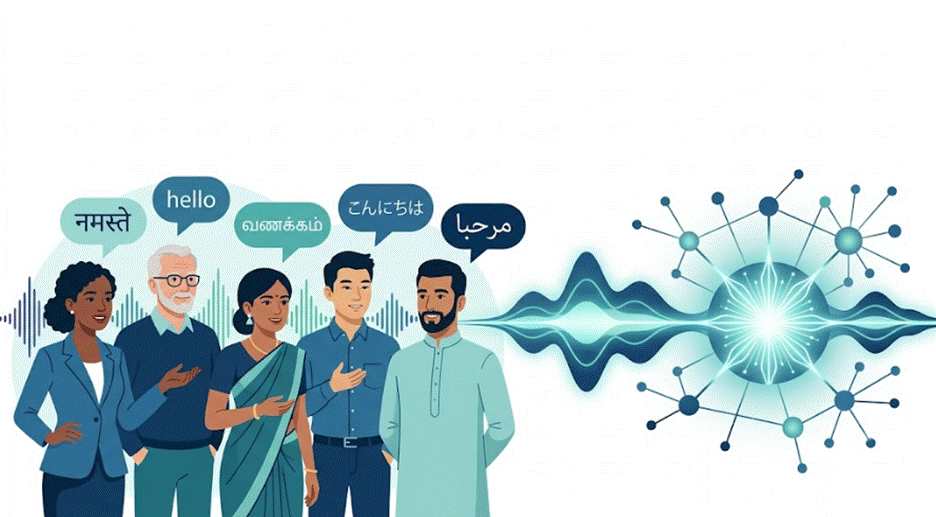
A speech model learns the voices it trains on, full stop. Feed it mostly American English, and it stalls the moment a Glaswegian, a Nigerian, or a Tamil speaker starts talking. This is not guesswork. A Stanford study of five leading speech systems clocked an average word error rate, the share of words the system gets wrong, of 35 percent for Black speakers against 19 percent for white speakers, traced straight to the acoustic models underneath. Independent 2025 benchmarks pushed older cloud speech APIs toward error rates near 0.35 on accented English. The same story replays for every dialect that never made the training set.
The real-world noise that labs quietly skip
Your users do not speak inside a padded booth. They talk in cars, kitchens, train platforms, and open-plan offices. They mumble. They shout over a crying baby. They use a cheap headset on a patchy line. Train on spotless studio reads alone, and your model meets reality and freezes. Far-field audio, the across-the-room kind, plus crosstalk and background din are not edge cases. For most products, they are the main event.
See also: Digital Tailoring and Fashion Technology
Why scraped and synthetic audio lets you down
Synthetic speech is cheap and quick. It is also a shortcut you pay for later. Generated audio misses the messy spread of real human voices, so models raised on it look great on benchmarks and crumble in the field. Scraped audio drags in a second headache: shaky consent and licensing that can detonate in a compliance review. Real audio data collection from consented speakers dodges both. You get the variety and the paperwork that survives an audit.
The hidden bill for a model that mishears
Every misheard word carries a price. A wrong order triggers a refund and a ticket. A failed command teaches a user to stop trusting the feature. A garbled medical transcript can cause real harm. Stack that across thousands of interactions, and a small accuracy gap turns into a churn engine. Accuracy is no vanity metric. It separates a feature people lean on from one they quietly walk away from.
| The gap most data vendors leave wide open Crowd marketplaces deliver scale, often with anonymous contributors, self-reported demographics, and patchy recording quality. You burn months scrubbing noisy files that still miss the speaker diversity your model needs. Humyn Labs shuts that gap with identity-verified speakers and documented demographics, so the data arrives right rather than getting fixed after the fact. |
What Voice and Audio Data Collection Actually Mean
Now that you can name the failure, let me draw a clean line between the two terms people throw around loosely.
Voice data collection versus audio data collection
voice data collection means recording human speech on purpose, to a spec: read prompts, spontaneous chat, wake words, emotional speech, multi-speaker dialogue. audio data collection is the wider bucket. It folds in speech plus other sound your model may need, such as ambient noise, environmental audio, and non-speech signals. For most voice AI teams the two overlap heavily, and a solid partner handles both in one pipeline.
The parts that make a dataset usable
- Speakers: verified identity, documented language, accent, dialect, age, and gender
- Scripts: phonetically balanced reads, natural conversation, commands, and emotional prompts
- Environments: quiet rooms, noisy spaces, far-field, and a range of devices
- Specs: sample rate, bit depth, noise floor, and the file format your pipeline expects
- Consent: documented, informed, and aligned with regional privacy rules
Why real beats synthetic for production
A model is only as honest as its data. Real speakers bring the hesitations, the regional quirks, and the acoustic clutter that synthetic audio sands away. That clutter is the whole point. It trains your model for the world it will actually face. For a deeper look at how this shapes speech-to-text systems, our team laid it out in this guide to speech recognition training data.
How to Fix a Mishearing AI: A Step-by-Step Approach
So which mistake is your model making right now? Whatever the answer, the path out is the same. Five steps, in order, the way we run it for teams shipping production voice AI.
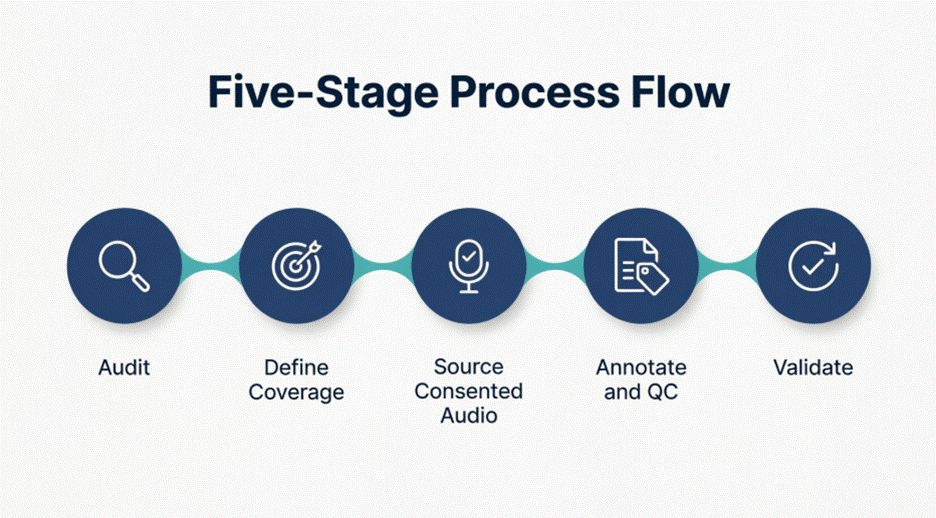
- Audit your error patterns. Pull your worst transcripts. Where does the model break, and for whom? Sort the errors by accent, language, noise level, and device. You cannot fix what you have not measured.
- Define your coverage targets. Pin down the exact demographics, languages, and acoustic settings you need. Get specific. “500 hours of Hindi female speakers aged 25 to 35 with Rajasthani accents” beats “more Indian data” every single time.
- Source consented, real-speaker audio at scale. This is the engine room of voice data collection. Verified speakers record to your spec in controlled settings, with consent logged from day one.
- Annotate, transcribe, and quality-check. Raw audio alone will not cut it. Accurate transcripts, speaker labels, and timestamps turn recordings into training fuel. Pair automated checks with human review.
- Validate against real edge cases before retraining. Test the fresh data on the very failures you found in step one. Did the Glaswegian accent improve? Did the noisy kitchen clear? Measure, then ship.
| Common mistakes to avoid Chasing a new model before checking your data. The fix usually lives in the audio, not the architecture. Treating synthetic audio as a full substitute. It flatters benchmarks and fails users. Ignoring consent until legal asks. Retrofitting licensing is far harder than logging it up front. Recording only clean studio reads. Your users live in noise, so your data should too. |
| Coverage checklist (worth a screenshot) Languages and dialects matched to your real user base Accent distribution defined on purpose, not left to luck Noise and far-field settings your users actually inhabit Device variety, from premium mics to budget headsets Emotional and conversational speech, not just tidy reads Documented consent and clear usage rights |
What Quality Voice and Audio Data Looks Like
Datasets are not equal. Here is the split between data that mends your model and data that merely fills a drive.
| Factor | Low-quality dataset | High-quality dataset |
| Accent diversity | Tilted to one or two accents | Mapped to your real user base |
| Noise variety | Clean studio only | Real-world noise and far-field |
| Speaker metadata | Self-reported or absent | Identity-verified and documented |
| Consent and licensing | Murky or scraped | Documented, GDPR-aligned |
| Annotation accuracy | Loose or automated only | Peer review plus central QC |
| Device range | Single device type | Phones, headsets, and mics |
Public corpora like LibriSpeech and Common Voice have their uses, but they tilt hard toward English, thin out on demographic balance, and carry licensing limits. For production voice AI, custom collection cut to your spec wins. Our speech datasets are built precisely that way.
The Business Payoff: What Better Audio Data Unlocks
Fixing your data is not a cost center. It is a growth lever. Picture a support line that misreads one in three callers with strong accents. Refunds climb, tickets pile up, and those customers churn. Now feed the model targeted voice data collection for those exact voices, and the line starts understanding them on the first try. Same product, very different P&L. Here is where that lever pays out.
Lower error rates, higher trust
Accurate transcription is the bedrock. As word error rates fall, every downstream feature sharpens: search, commands, analytics, and compliance. Fine-tuning on as little as 10 to 100 hours of targeted speech can hone a model for a specific language or domain, and a strong voice data collection program supplies that fuel.
Wider reach into new markets
Every language and accent you cover is a market you can open. Indic languages alone, Hindi, Tamil, Telugu, Kannada, Malayalam, Bengali, Marathi, unlock hundreds of millions of users that English-first models leave stranded. We unpack this in our piece on multilingual AI data and Indic NLP.
Fewer escalations, happier users
When your voice feature gets people right the first time, support load drops. Contact centers are forecast to save around $80 billion in labor costs in 2026 through conversational AI, and per-call costs can slide from $7 to $12 with a human agent toward roughly $0.40 with voice AI. None of that arrives if the AI mishears the caller. Accuracy is the gate to every one of those savings.
Faster, defensible iteration
Consented data means no legal landmines when you retrain. You move fast, and you can defend your dataset in any audit. That is the entire reason to build on real, verified audio data collection.
Why Generic Datasets Fail and Custom Collection Wins
Off-the-shelf corpora are shared, stale, and shaped for somebody else’s problem. Your competitor trained on the same files. That is not an edge. At best it is a draw.
Custom voice data collection targets your exact gaps: the accents your users carry, the noise they sit in, the commands they really say. Here, human-in-the-loop matters. Verified people, not faceless crowds, gather and check the data, so quality is built in rather than patched on later. You can see how that human-in-the-loop approach runs across our pipelines.
How Humyn Labs Handles Voice and Audio Data Collection
We built Humyn Labs for this exact problem. Real human intelligence, at scale, with proof you can stand behind.
Verified speakers across 50+ languages
Every speaker is identity-verified, with documented language, accent, dialect, age, and gender. No self-reported guesses. That metadata is what lets you steer distribution and truly close the gaps your audit surfaced. See the full scope on our voice data collection page.
Studio-grade standards on every file
Recordings follow set specs for sample rate, bit depth, noise floor, and clipping. We reject files that miss the mark before they ever touch your pipeline. You are not the one mopping up.
Demographic precision at scale
Need 500 hours of one dialect, age band, and gender? We source exactly that. You steer the distribution instead of praying a public dataset happens to cover it. Browse the wider data collection solutions to see the full range.
Privacy, consent, and QC built in
Every speaker gives verified informed consent, and handling follows GDPR and regional rules. Then every recording clears data quality assurance: automated checks for noise and clipping, plus human review for transcript accuracy. Peer review meets centralized QC. Need labels on files you already hold? Our audio transcription and data annotation services run in the same pipeline.
| From request to dataset in 48 hours Tell us the languages, demographics, and recording specs. We hand back a collection plan and sample recordings within 48 hours, then deliver in milestones so you can train on early batches. Book a call to scope your project. |
Frequently Asked Questions
What is voice data collection for AI?
It is recording human speech under controlled conditions to build training datasets for speech models. That covers read speech, natural conversation, command words, and emotional speech, captured by verified speakers with documented demographics in settings that hit defined quality standards.
Why does my AI mishear certain accents?
Because it almost certainly never trained on them. Speech models echo the voices in their training data. When an accent or dialect is underrepresented, the model returns higher error rates for those speakers. The cure is adding diverse, real speech that mirrors your users.
Is synthetic audio good enough to train a speech model?
For production, rarely on its own. Synthetic audio lacks the messy spread of real voices and settings, so models built on it tend to shine on benchmarks and stumble in the field. Real, consented speech delivers both variety and clean licensing.
How much audio data do I need to fix my model?
It depends on the goal. A pilot of 50 to 100 hours in one or two languages is a common starting point. Fine-tuning for a specific language or domain can work with 10 to 100 hours, while large builds run past 1,000 hours across many languages.
What is the difference between audio data collection and voice data collection?
Voice data collection centers on recording new human speech to a spec. Audio data collection is broader and can fold in non-speech sound your model needs. Humyn Labs handles both, plus annotation and transcription, in a single pipeline.
How do I get consented, high-quality voice data?
Partner with a team that verifies speaker identity, documents demographics, captures informed consent, and runs layered quality control. Humyn Labs does all four, then delivers in your format with full metadata.
The Bottom Line
An AI that mishears people is a fixable problem, not a life sentence. You traced it to the root: thin, clean, lookalike training audio that never matched real life. You hold the path now. Audit the failures, define the coverage, source real consented speech, check it hard, and validate against the exact cases that broke before.
Do that, and the misheard words start to vanish. Error rates drop. New markets open. Tickets thin out. And your voice feature becomes something people trust rather than tolerate.
That is what real voice data collection and audio data collection buys you. If you are ready to quit scrubbing noisy files and start training on data built to your spec, talk to Humyn Labs and we will scope it with you.
| Ready to fix what your model mishears? Get verified speakers, 50+ languages, and studio-grade recordings matched to your exact use case. Scope your dataset or see how Humyn works. |