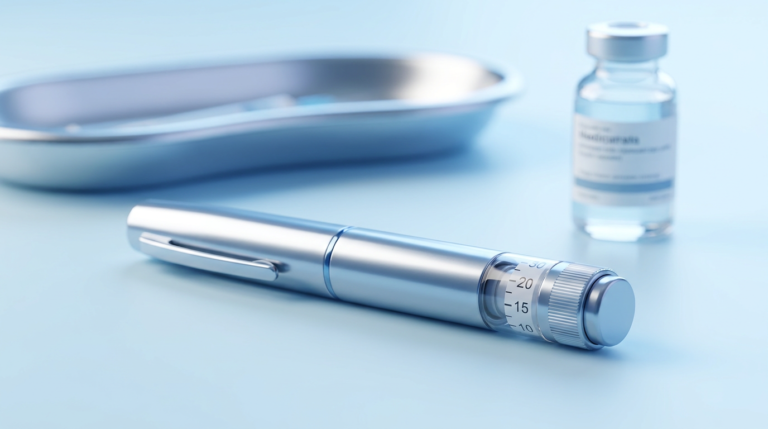

The important question around ghk cu is practical: what is actually known, what remains uncertain, and what safeguards a licensed clinician and pharmacy process add before anyone treats it as an option.
A friend of mine, Laura, is a 48-year-old nurse practitioner outside Portland who started researching GHK-Cu after her dermatologist mentioned it during a routine skin check last fall. She’d noticed the elasticity in her jawline changing faster than she expected, her post-workout recovery dragging, and her hair thinning at the temples in a way that felt distinctly perimenopausal. She came to me with a printout from a peptide forum and a simple question: “Is any of this real, or is it just expensive hope in a vial?”
That question is a good one. And the honest answer is: some of it is real, some of it is extrapolated beyond what the data support, and the difference matters a lot when you’re deciding whether to spend $300 a month on a compounded injectable.
The Molecule Itself: What GHK-Cu Actually Does
GHK-Cu (glycyl-L-histidyl-L-lysine complexed with copper) is not some exotic synthetic. It’s endogenous, meaning your body already makes it. The problem is that your body makes progressively less of it as you age. Plasma levels drop roughly 60% between age 20 and 60, which tracks uncomfortably well with the timeline of skin thinning, slower wound healing, and declining tissue repair capacity that most women start noticing in their 40s.
Pickart and Margolina published a thorough review in Oxidative Medicine and Cellular Longevity (2015) detailing GHK-Cu’s effects on wound healing, collagen synthesis, antioxidant gene expression, and stem cell regulation. The peptide has been shown to modulate over 4,000 genes in human cells, including genes tied to DNA repair, antioxidant response, and tissue remodeling. That’s a big number, and it’s both the appeal and the source of confusion. Because when something affects 4,000 genes, everyone projects their favorite outcome onto it.
The mechanism is well characterized and reproducible across studies (Pickart, Curr Med Chem, 2008), which gives it a higher baseline of confidence than many peptides floating around the wellness space. But “well characterized mechanism” and “proven clinical benefit for your specific concern” are not the same sentence.
What the Research Supports (and Where It Thins Out)
The strongest evidence clusters around wound healing. That’s where Pickart’s foundational work in the 1980s started, and subsequent dermatologic literature has examined GHK-Cu’s effects on photoaged skin, post-procedure recovery, and scarring with reasonable consistency.
For skin elasticity and fine lines, there’s legitimate support in the literature (Pickart, Vasquez-Soltero, and Margolina, Biomed Res Int, 2015), particularly in topical formulations. Hair follicle stimulation shows up in smaller clinical and observational reports, enough to be interesting but not enough to call it settled.
Here’s my opinionated take: GHK-Cu is probably the most evidence-backed peptide in the aesthetic and tissue-repair category, and it’s still not close to the standard of evidence we’d demand from an FDA-approved drug. That’s not a reason to dismiss it. It is a reason to be specific about what you’re trying to accomplish and honest about what “success” would look like in your case.
Think of it like this: if clinical evidence is a ladder, GHK-Cu for wound healing is standing on a solid middle rung. GHK-Cu for hair regrowth is maybe two rungs lower. GHK-Cu for “anti-aging” as a general concept is hanging off the side by one hand. The ladder is the same, but where you’re standing on it changes the risk calculus entirely.
Where an FDA-approved alternative exists for the indication you care about (topical retinoids for photoaging, minoxidil for hair loss), the conservative starting point is that alternative. Common reasons to consider GHK-Cu instead include contraindications to the approved option, inadequate response, intolerable side effects, or a specific clinical rationale your prescriber can articulate.
How Compounded Protocols Actually Work
Subcutaneous protocols typically run 1 to 2 mg per injection, two to three times weekly, in cycles of 8 to 12 weeks. Topical formulations range from 0.05% to 0.2% in serums or creams, applied daily. Targeted intradermal use for hair or scarring (often paired with microneedling or mesotherapy) is dosed per prescriber direction.
Reconstitution uses bacteriostatic water. Storage is refrigerated. You use insulin syringes, typically 30-gauge, rotating abdominal subcutaneous injection sites. Pharmacies provide beyond-use dating that should be followed precisely, not approximately.
A few things worth knowing that don’t always make it into the marketing copy:
Higher doses don’t generally produce proportionally better outcomes. They frequently increase side-effect burden (injection site irritation, bruising) without meaningful additional benefit. Conservative dosing with longer cycles and documented baselines produces far more useful information about whether the peptide is actually doing something for you.
Don’t stack multiple new peptides simultaneously. It’s like changing three variables in an experiment at once: if something improves (or worsens), you have no idea which molecule caused it. Start with one peptide, define your endpoints, run a full cycle, evaluate. Then decide.
Monthly costs currently range from roughly $150 to $500 depending on dose, cycle length, and pharmacy. Insurance coverage for off-label compounded peptides is uncommon, so expect to pay out of pocket. When comparing prices, calculate the total cost of a complete cycle (intake consultation, prescription, dispensing, shipping, follow-up, and any labs) rather than fixating on per-vial pricing alone. The cheapest vial from the least transparent operator is rarely the best value.
For women evaluating sourcing options, the FormBlends platform integrates intake, prescriber relationship, and 503A pharmacy dispensing into a single workflow. You can review their GHK-Cu offering at https://formblends.com/peptides/ghk-cu and compare it against other compounding sources on prescriber access, pharmacy quality, product specifications, and total cycle cost.
Side Effects, Safety, and When This Isn’t for You
GHK-Cu is generally well tolerated. The most common complaints are transient redness or irritation at injection or application sites, mild bruising, and (rarely) allergic responses. Long-term injectable safety data in healthy adults are limited, though the peptide’s endogenous nature reduces the theoretical risk profile compared to fully synthetic molecules.
Hard contraindication: Wilson’s disease or other copper metabolism disorders.
Soft contraindications requiring explicit prescriber review: active oncologic history, uncontrolled metabolic disease, cardiovascular concerns, pregnancy or breastfeeding, or concurrent use of anticoagulants, GLP-1 agonists, SSRIs, HRT, or other prescription therapy. That last one matters a lot for perimenopausal women who may already be on estrogen, progesterone, or testosterone. Your prescriber needs to know everything you’re taking.
The boring truth is that most poor experiences with compounded peptides trace back to mismatched expectations, sloppy dosing, or skipped baseline measurement, not the peptide itself. Take photos. Record subjective scores. Get labs where your prescriber recommends them. Define what would make you stop the cycle (specific side-effect thresholds, lab values that would trigger a pause). Cycles without those guardrails tend to drift into open-ended use that’s impossible to evaluate honestly.
Perimenopause Context: Why This Keeps Coming Up
GHK-Cu’s relevance to perimenopausal women isn’t hard to trace. The peptide declines during the same years that estrogen and progesterone are declining, collagen production is dropping (women lose roughly 30% of their dermal collagen in the first five years after menopause), wound healing is slowing, and hair density is changing. It makes biological sense to ask whether replacing something that’s declining might help.
But biological plausibility is a hypothesis, not a clinical result. The women I’ve talked to who seem most satisfied with GHK-Cu protocols are the ones who went in with a specific, measurable goal (post-procedure healing time, a particular scar, documented skin elasticity changes) rather than a vague hope for “turning back the clock.” Specificity protects you from both disappointment and indefinite spending.
Frequently Asked Questions
Is GHK-Cu FDA-approved?
No. Compounded peptides are prepared by licensed 503A pharmacies for individual patients based on a prescriber’s clinical judgment. The 503A regulatory pathway is distinct from FDA new drug approval and applies to individualized compounding.
How long until I notice an effect from GHK-Cu?
It depends on the indication. Acute effects on sleep or injection-site skin quality can appear within days. Recovery and aesthetic effects typically need 4 to 12 weeks of consistent dosing. Documented baselines (subjective scores, photos, labs) help separate real change from wishful thinking.
Can I use GHK-Cu alongside hormone replacement therapy?
Often yes, under prescriber supervision. But timing, dosing, and lab monitoring need to be coordinated. Your prescriber should know every medication and supplement you’re taking before building a protocol.
Is GHK-Cu safe to use long-term?
Long-term use is reasonably supported in established indications, though off-label use beyond several years has limited data. Cycle-based protocols remain standard practice. Documented endpoints support better long-term decision-making either way.
How do I know a compounding pharmacy is legitimate?
Check for state board licensure, PCAB accreditation, transparent sourcing and testing practices, ability to provide a certificate of analysis on request, and a clear prescriber relationship. Operators that avoid those questions or bypass prescriber involvement should raise immediate red flags.
Does GHK-Cu require a prescription?
Yes. Compounded peptides require an individualized prescription from a licensed clinician. Vendors selling these molecules as “research chemicals” without prescriber involvement are operating outside the 503A framework entirely.
What labs should I run before starting GHK-Cu?
Baseline labs depend on your full protocol. A baseline metabolic panel and CBC are standard. If you’re running GH-axis peptides alongside, add IGF-1, fasting glucose and insulin, and a lipid panel. Mid-cycle and end-cycle labs help verify whether the protocol is producing measurable biochemical changes, not just subjective impressions.
The Bottom Line
GHK-Cu is most useful when it fills a specific gap, not when it’s added as a general “wellness” layer. For perimenopausal women, the relevant question isn’t whether the peptide is “good” in the abstract. It’s whether it addresses a defined concern better than (or in addition to) existing options, and whether you can measure the answer.
Laura, the NP from Portland, ended up running an 8-week subcutaneous cycle targeting post-microneedling healing and jawline skin quality. She took photos every two weeks, kept a simple symptom log, and had her prescriber review at week 4 and week 8. Her results were modest but visible, and she felt the data justified a second cycle. That’s about as good as informed decision-making gets with compounded peptides.
Not FDA-approved. Compounded peptides are prepared by licensed 503A pharmacies for individual patients based on a prescriber’s clinical judgment. This article is for educational purposes and does not constitute medical advice. Individual results vary and outcomes depend on clinical context, prescriber assessment, and adherence to protocol. Talk to a licensed clinician before starting any new therapy.